How to Measure Strike and Dip in the Field — A Complete Guide
Strike and dip are the two most fundamental measurements in structural geology. This guide walks you through everything — from basic definitions to field technique, common mistakes, and modern digital tools.
1. What Is Strike and Dip?
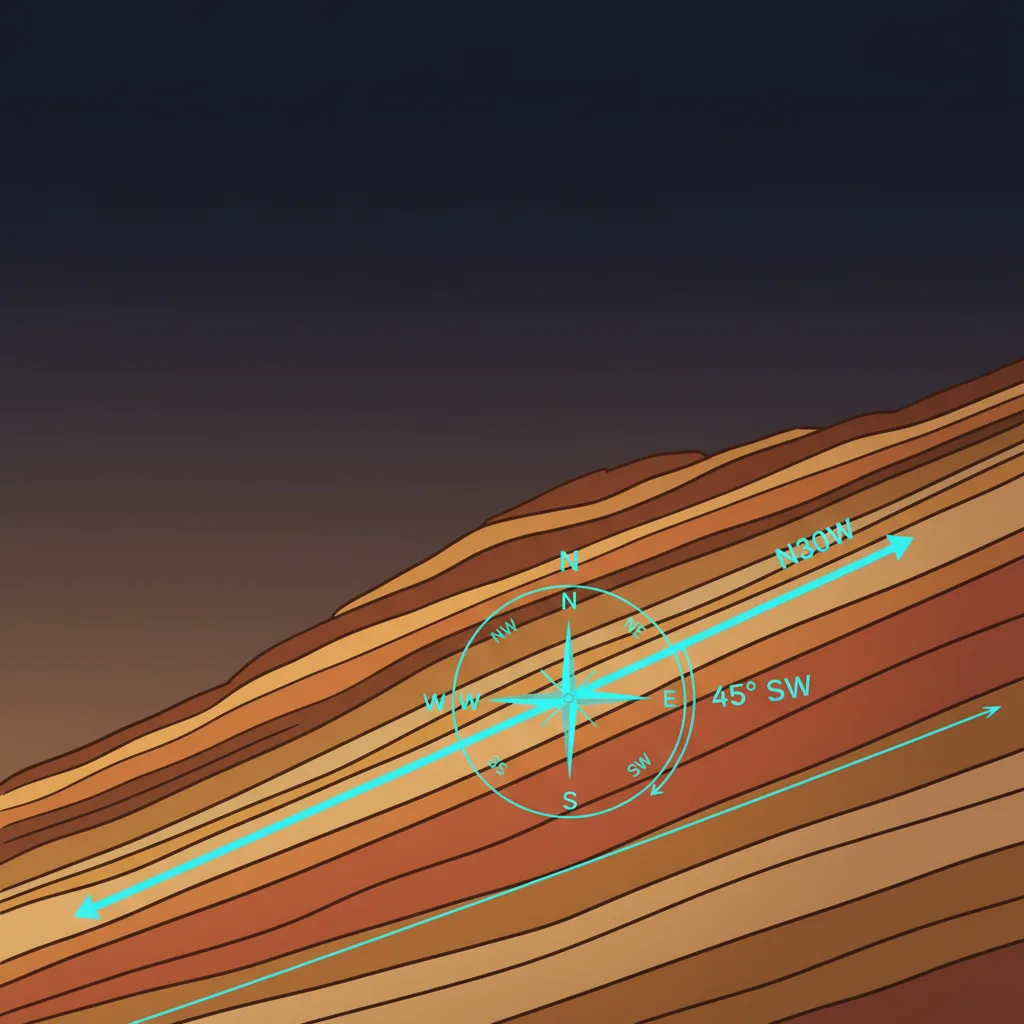
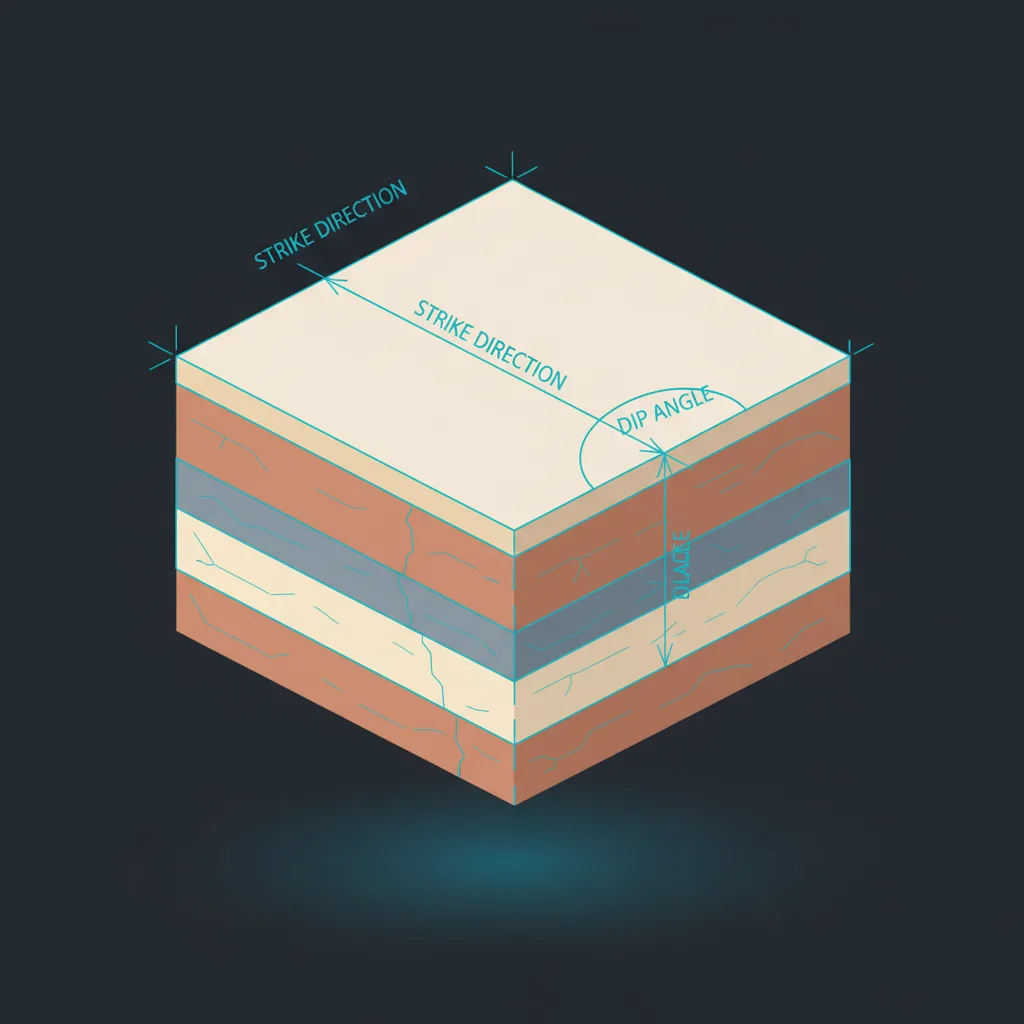
Strike is the compass direction of a horizontal line on a tilted geological plane — such as a bedding surface, fault plane, or foliation. It's measured as an azimuth (e.g., N45°E or 045°).
Dip is the angle of maximum inclination of that plane, measured downward from horizontal. Dip is always perpendicular to strike. A dip of 30° means the plane tilts 30 degrees from horizontal.
Together, strike and dip uniquely define the orientation of any planar geological feature in three-dimensional space. This makes them essential for geological mapping, cross-section construction, and structural analysis.
Example notation: A bedding plane with strike N30°E and dip 45°SE is written as 030/45 SE or N30E 45SE.
2. The Right-Hand Rule
The right-hand rule is a convention that eliminates ambiguity when recording strike and dip. Instead of writing a separate dip direction, you orient the strike azimuth so that the dip is always to your right.
How it works: Stand facing along the strike direction. If the surface dips to your right, that's the correct strike azimuth. If it dips to your left, rotate 180° — the new direction is your right-hand-rule strike.
Using the right-hand rule, the notation simplifies to just two numbers: 030/45 — the dip direction is implied (always to the right of strike).
Tip: Many geology programs and GIS tools assume right-hand rule input. Using this convention from the start avoids conversion headaches later.
3. Measuring with a Brunton Compass
The Brunton pocket transit is the traditional tool for measuring strike and dip. It combines a magnetic compass, clinometer (inclinometer), and sighting device in one instrument.
Measuring Strike
- Find an exposed planar surface (bedding plane, fault surface, joint face).
- Place the long edge of the Brunton flat against the surface, keeping it horizontal (use the bull's-eye level).
- Read the compass bearing from the needle — this is the strike.
Measuring Dip
- Rotate the compass 90° so the short edge is aligned along the dip direction (perpendicular to strike).
- Place the edge against the surface and read the clinometer — this is the dip angle.
- Note the direction the surface dips (N, S, E, W, or a combination).
4. Step-by-Step Field Procedure
Identify the surface
Look for a clear, exposed planar feature. Bedding planes are easiest. Remove loose debris if needed.
Check for true planarity
Make sure the surface is actually planar over the area you're measuring. Undulating surfaces give unreliable readings.
Measure strike
Place the compass horizontally against the surface and read the bearing. Apply the right-hand rule.
Measure dip
Rotate 90°, place clinometer edge on the surface, and read the dip angle. Note the dip direction.
Record and verify
Write down the measurement, GPS coordinates, and any geological context. Take a second measurement nearby to verify consistency.
5. Common Mistakes to Avoid
Measuring apparent dip instead of true dip
If you don't measure perpendicular to strike, you get the apparent dip — which is always less than true dip. Always ensure your dip measurement is at 90° to the strike direction.
Magnetic interference
Iron-rich rocks (magnetite, pyrrhotite) or nearby metal objects can deflect compass needles. Step away from vehicles and metal equipment before taking readings.
Forgetting magnetic declination
Magnetic north differs from true north. Set the declination on your Brunton for your field area, or apply the correction to each reading. (Digital tools like GeoKit apply this correction automatically and label each record with its north reference.)
Measuring on weathered surfaces
Weathering can change the apparent orientation of surfaces. Look for fresh exposures or use a hammer to clear the weathering rind.
6. Recording Strike & Dip Data
There are two common notation conventions used worldwide:
Quadrant Notation
Uses N/S/E/W to express the strike direction.
N45E 30SE
Azimuth Notation
Uses a three-digit azimuth (0–360°).
045/30
In your field notebook, always include: the measurement, GPS coordinates (or station number), the geological feature measured (bedding, foliation, fault, joint), and any relevant context (formation, lithology).
7. Digital Geological Compass Apps
Modern smartphones contain magnetometers and accelerometers — the same sensor types used in physical compasses and clinometers. Digital geological compass apps leverage these sensors to measure strike and dip directly from the phone screen.
The big advantage over an analog compass: no two-step alignment is needed. Because the phone's accelerometer senses the full orientation of the surface it rests on, a digital compass can compute strike, dip, and dip direction from a single placement.
Measuring with GeoKit — one step
- Open the Strike & Dip tool and lay your phone flat on the rock surface — any orientation works; there's no need to align an edge with the strike line.
- Hold still for a moment. When the reading stabilizes, GeoKit auto-locks strike, dip, and dip direction together.
- Tap Save to record the measurement with GPS coordinates, altitude, rock type, and an optional photo.
GeoKit's strike & dip compass is a free digital compass designed specifically for geological fieldwork. It provides:

Should you ditch the Brunton? Not necessarily. A digital compass is excellent for rapid data collection and for students who don't own a Brunton. But for high-precision structural mapping, many geologists use both — the digital app for speed, the Brunton for verification.
8. Practice Tips for Geology Students
Start with obvious surfaces
Practice on clearly defined bedding planes in sedimentary rocks before attempting foliation or fracture surfaces.
Take multiple readings
Measure the same surface 3 times and average the results. This builds confidence and reveals measurement errors.
Compare digital and analog
Use GeoKit alongside a Brunton compass. Comparing readings helps you understand both tools and identify calibration issues.
Plot on a stereonet immediately
Plotting your measurements on a stereonet while still in the field helps you spot patterns and errors before leaving the outcrop — here's how to read one.
Ready to Try It in the Field?
GeoKit's digital geological compass is free on iOS and Android. No subscription — just download and start measuring.